

What Nine Years of Strength Coaching Has Taught Me About Motivation
Problems are motivating.
Motivation comes from the Latin word movere, which means to move.
To get going, you need to figure out what gets you going.
If I am stiff as a board when I wake up in the morning, can’t walk downstairs because of my knee pain, or keep losing my balance, I have a concrete problem to solve.
When I have identified a problem that I want to solve, I can plan what I need to do to solve it.
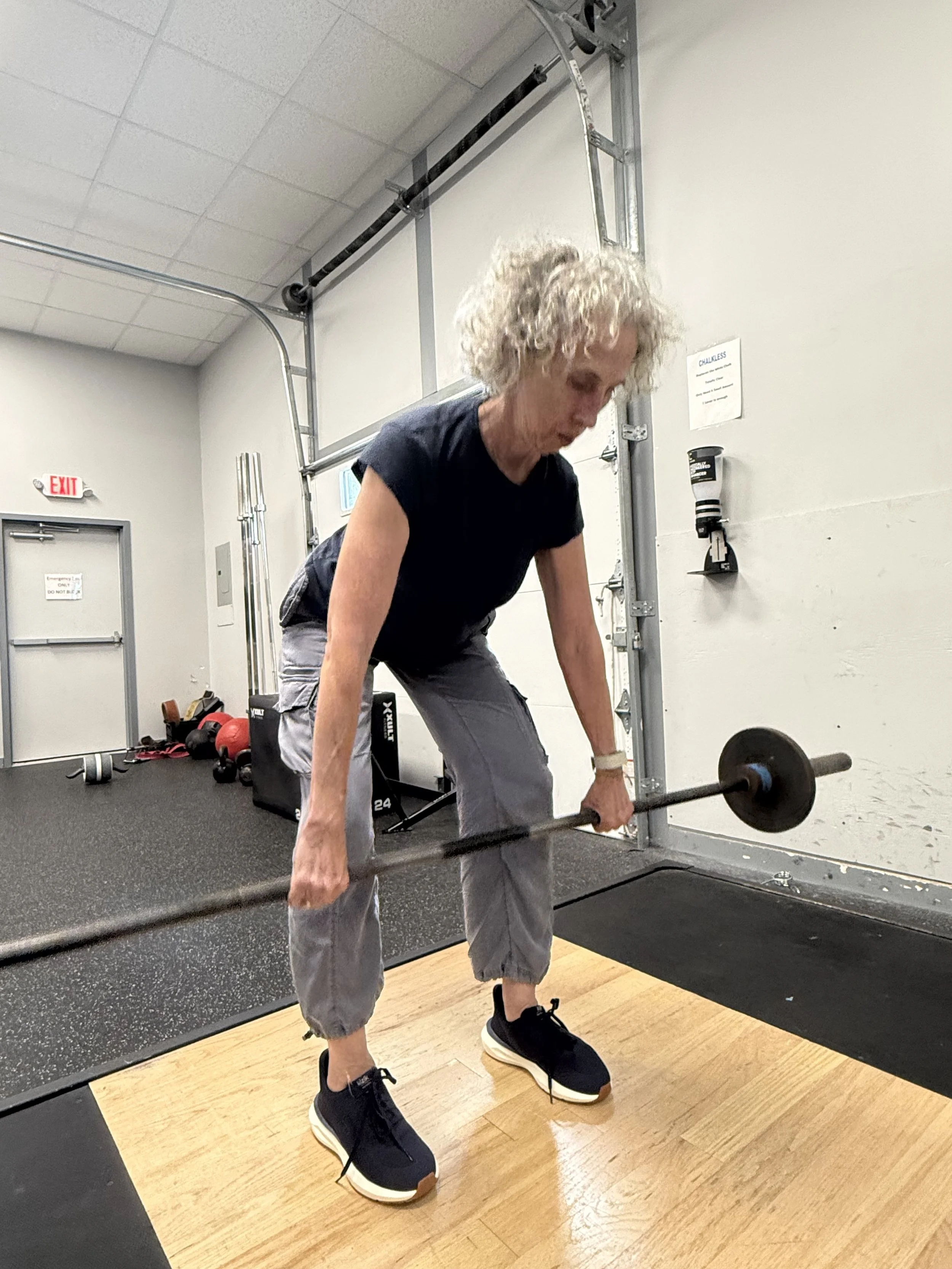
Photo by Robin Clark
This is where a SMART goal can be useful. Using these five metrics provides you with actionable steps to take.
Specific
Measurable
Achievable
Relevant
Time-Bound
I’ll use the example of being diagnosed with osteoporosis in January 2025.
Specific: I set the goal of improving my next DEXA scan, scheduled for December 2026.
Measurable: I will have achieved my goal if my next scan shows improvement or remains unchanged. I will be crushed if my numbers are worse.
Achievable: I have expanded what I am willing to do as I have learned and made progress. I added hormone replacement therapy. I dialed up my strength training to three times a week, featuring progressive loads. I added post-strength interval rowing and a jump sequence. Most recently, I shifted my rowing to the beginning of my workout before the jumps. I also added a heavy-lift session at the local Y, where I can access weights heavier than the ones I have.
Relevant: Everything I have added is there for a reason. My program is focused on building strength and supporting bone growth.
Time-Bound: I have a date: December 2026. And to make sure I actually do the work between now and then, I blacked out my calendar at 7 AM Monday, Wednesday, and Friday. For 60 minutes, nothing else can be scheduled. When I can, I preserve 90 minutes.
I have been true to this plan for going on 20 months. I feel strong and confident that I am doing everything in my power to solve this problem.
And maybe that is what I have learned about motivation.
I don’t need to wake up every Monday, Wednesday, and Friday feeling motivated to exercise. I am motivated by the problem I decided to solve. The plan tells me what to do next.
I go through the same process with clients.
Nancy had tripped and fallen stepping out of her house. We created a plan to improve her balance and reduce her risk of falling.
Louise had abdominal surgery scheduled in a month. We focused on core strength—front, back, and side—and her doctors were impressed with her post-surgery recovery.
Each woman had a problem they wanted to solve. That gave us the motivation. Then we used the SMART strategy to create the plan.
What problem do you want to solve?
Then build a plan specific enough to do something about it.
I can’t wait to share my DEXA scan results in December.