

Most workouts focus on exercises.
Strong bodies are built by training movement patterns.
Instead of thinking about individual exercises, think about how your body moves: hinging, squatting, lunging, and moving side to side.
Train those patterns well, and your lower body becomes stronger, more stable, and more capable in everyday life.
This article is for people who like to learn through words. If you prefer demonstrations, head to my YouTube channel.
The Five Lower-Body Movement Patterns to Train
A strong lower body comes from training these five movement patterns:
1. Hip hinge
2. Squat
3. Single-leg work (lunges or split stance)
4. Lateral movement
5. Calf and ankle strength
Let’s look at each one.
The Hip Hinge: The Foundation of Lower-Body Strength
A hip hinge may sound alien, but, in fact, when you sit in a chair, you naturally hinge at the hips, sending your glutes back toward the seat. But when I ask the average person to squat — which is essentially sitting without a chair — they often lead with their knees instead of their hips.
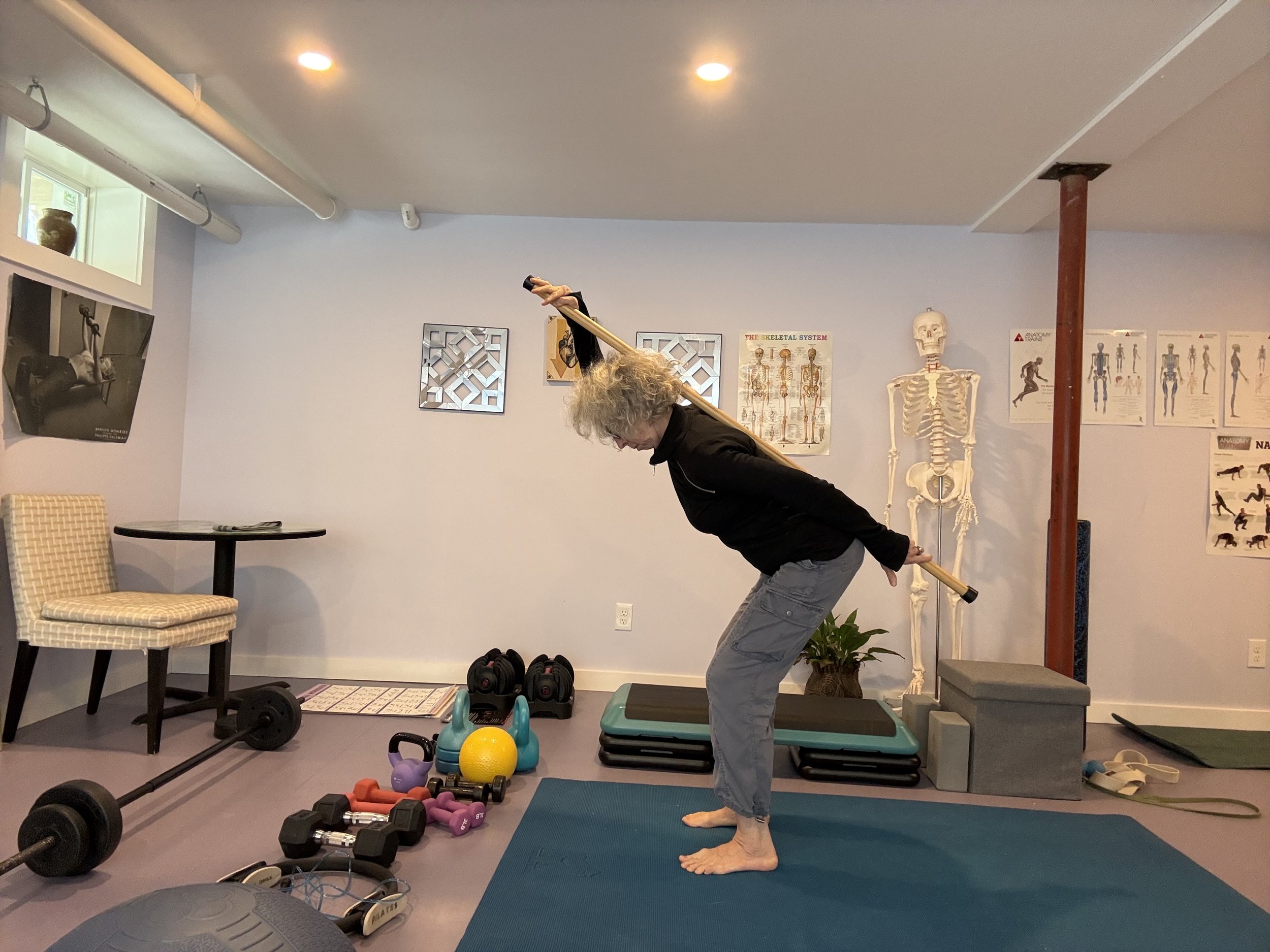
The hip hinge is a key motion to master so you can execute at will. Stand tall and hinge from the hips, sending your glutes back while keeping a long neutral spine and proud chest.
A great way to test your hinge is to get a pole, umbrella, or broomstick and hold it with one hand above your head and the other hand below your hip. Feel contact with your head, upper back, and glutes on the stick. Hinge and keep contact at all three points throughout the whole gesture. Watch for your head or glutes dropping away. If you stay connected, you have hinged with a nice, long spine.
We need to pick things up off the ground all the time. The hip hinge is the safest way to do it. You may recall people saying bend your knees when you pick up something heavy. Hinge your hips first. Hinge your hips and bend your knees to lift.
The Squat: Sitting Without a Chair
In Yoga, we call it Chair Pose. That is your big clue. If you can sit in a chair, you can squat. Begin your practice by using a chair. As you feel more secure, step away from the chair and squat slightly. Add depth as you get more secure. The action begins with a hinge of the hip; your long spine reaches forward as your hips, knees, and ankles bend. Chest stays proud, collarbones wide, neck and head in line with your spine. Start by standing hip-width apart. You can grow your practice by stepping wider with toes out and heels in. Play with tempo. Deepen as you build strength.
Single-Leg Work
There are all kinds of reasons why we need to do something on one leg. Training lunges is a great way to support everyday life activities. There are two directions you can go. Stepping one foot forward is a forward lunge. Step far enough forward to finish with your front knee bent over your ankle. The opposite is a reverse lunge. Step backward, landing with that foot on the ball. You can put the whole foot down if that feels more stable. From there, you want to see if you can bend that knee toward the floor. You may bend a fraction and then lengthen. You may bend until your knee reaches the floor and then return to the starting position.
I’ll stop with lunging for today. There are also moves like the single-leg deadlift or Warrior III that involve balancing on the front leg.
Lateral Movement
We also need to move side to side. Think of getting into a car or bed. There are a number of ways to train this movement. Start by standing hip-width apart with room to step to either side. Step your left foot to the left, toes out and heels in, bend your left knee, and push your hips toward the knee, allowing your knee to go out over your toes. Return to the center and repeat on the other side. In a training session, you may do 8–12 reps and complete three sets. Another way to train lateral movement is by stepping up to the side. You can do this on a stair or a low box, or a step.
Calf and Ankle Strength and Mobility
Your calves and ankles stabilize your legs. It is not uncommon to have a mobile ankle and to feel stiff in your calves. Calf raises train the ankles and calf muscles. If you are on a level floor, raise your heels together as high as you can, keeping your foot level. Return to ground level and repeat. If you have access to a stair or raised level, stand with the ball of your foot on the stair and your heel in the air off the step. Lift your heels up in a steady calf raise. As you lower, allow your heels to descend to stretch your calf. Repeat 8–12 times for 3 sets to build strength and stability.
Training Structure
Your legs contain many endurance-oriented muscles and can tolerate frequent training.
A simple approach is to train one exercise from each movement pattern:
• Hinge
• Squat
• Lunge / single-leg work
• Lateral movement
• Calf/ankle work
Perform 8–12 repetitions of each exercise for three sets.
This simple structure trains the entire lower body efficiently while building strength, stability, and mobility.
The Key Takeaway
Many people stay active but never become stronger because their workouts lack structure or progression.
When you train movement patterns instead of random exercises, your body becomes more capable — not just in workouts, but in everyday life.
That’s the goal.
Want to See These Movements?
If you’re a visual learner, you can see demonstrations and training ideas on my YouTube and Instagram.
And if you want help building a structured strength program, feel free to reach out.