

Everyone Has a Pelvic Floor. Most People Don’t Know How to Use It.
Why breath and pressure management matter more than endless Kegels
Everyone has a pelvic floor.
It often gets labeled as a women’s health topic, but everybody has one. A diamond-shaped group of muscles forms the base of the pelvis. These muscles support posture, movement, and breath.
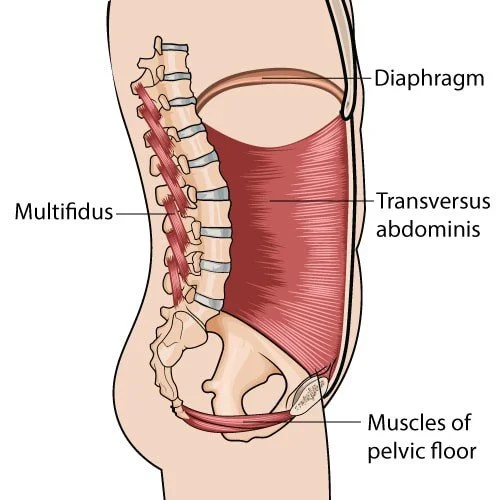
Graphic by https://bendandmend.com
Most of us were taught exactly one thing about it:
Do Kegels.
That’s not wrong.
But squeezing alone misses too much.
The pelvic floor doesn’t operate by itself. It’s part of your core system. It responds to your breath. It manages pressure every time you lift, stand up, cough, or carry groceries.
If you take one thing from this article, take this:
If you’re going to Kegel, connect it to your breath.
Your pelvic floor naturally relaxes when you inhale. It gently lifts when you exhale.
Your diaphragm does the opposite. It descends on the inhale as the ribs expand and the belly softens. It rises on the exhale.
This is a coordinated system.
So instead of randomly squeezing throughout the day, think lift on the exhale.
That shift alone can change how your core feels and functions.
This is the work I focus on in my coaching.
I’m an ACE-certified personal trainer and a Yoga Medicine® Registered Therapeutic Specialist. I work with strength, breath mechanics, and core function. I’m not a physician or pelvic floor physical therapist. If you’re dealing with pain or significant symptoms, those professionals belong on your team.
This Can Feel Personal
We are talking about an intimate area of the body.
I’m writing this because clients bring it up all the time. Incontinence. Prolapse. Pain. Constipation. A sense of weakness they can’t quite name.
If you’re uncomfortable or unsure, don’t ignore it. Talk to a qualified medical professional. There is help available.
Training Is Not One-Dimensional
Think about your biceps.
You don’t build strength by keeping your elbow bent all day. Muscles need to shorten and lengthen. Contract and release.
The pelvic floor is no different.
We want it to lift. We also want it to let go.
Breathing gives us that rhythm naturally — unless we override it by gripping constantly.
Just as I vary exercises for biceps, I use different movements to strengthen and lengthen the pelvic floor. I created a guided session that walks through this approach if you want to explore it in a structured way.
Your Pelvic Floor Is the Base of Your Core
The body works as a system.
Muscles from your ribs — front, sides, and back — coordinate with the pelvic floor to support your torso. When you understand how the pelvic floor functions, you improve core stability and overall strength.
Pelvic floor health shows up everywhere: lifting weights, picking up groceries, posture, back comfort, sleep, even confidence.
Trying to isolate it completely misses the point.
A Kegel-only strategy ignores how the body is actually designed to work.
The Goal Is Coordination, Not Clenching
The pelvic floor isn’t meant to be held tight all day.
When we reduce it to “just squeeze,” we oversimplify a very intelligent system.
Strength isn’t constant contraction. It’s control. It’s range. It’s knowing when to engage and when to let go.
If you remember nothing else, remember this:
Lift on the exhale.
Allow release on the inhale.
Let the system do what it was designed to do.
That’s how you build real strength.
If you’d like to go deeper, I created a guided session that walks you through the process step by step.